
Contents
In lean organizational structures, the process of introducing new members often becomes the biggest friction point. When human resources are limited, seniors or managers must split their time between executing daily tasks and transferring knowledge to newcomers. This situation creates a classic dilemma. If training is conducted intensively, team productivity declines. If it is minimal, new members take longer to reach independence. As a result, work quality during the initial joining period tends to be unstable due to a lack of historical context and understanding of team work norms.
A frequently overlooked solution is leveraging existing assets that are rarely well-structured, namely conversations in meetings. Meetings are not just forums for decision-making; they are places where business logic, work style preferences, and operational procedures are explained explicitly or implicitly. By transforming meeting transcripts into searchable reference material, small teams can build an organic knowledge base that reflects their operational reality, rather than just ideal theory written in formal documents.
The Gap Between Formal Documents and Operational Reality
Many companies have procedure manuals or internal wikis that are updated periodically. However, these documents are often static and lag behind day-to-day dynamics. New members reading the manual may understand technical steps, but they miss important nuances such as how to handle inter-departmental conflict escalations, who the key stakeholders are for quick approvals, or why a certain policy is implemented despite appearing inefficient on the surface. This critical information is usually stored in the team's collective memory and resurfaces during discussions or routine meetings.

The mismatch between what is written and what happens on the ground causes confusion during the early onboarding phase. New members feel the need to ask repeatedly about things that were actually discussed previously by other colleagues. This not only consumes senior staff's time but also makes new members feel like a burden. Shifting the focus from creating new documents to utilizing existing conversation data allows teams to bridge this gap in a more natural and relevant way.
Transcripts as a Source of Decision Context
One of the biggest challenges for new employees is understanding the reasons behind a decision. Without historical context, instructions can seem arbitrary or confusing. Meeting transcripts provide a verbal audit trail explaining how an idea evolved, which arguments were rejected, and what compromises were reached before the final decision was made. When new members can trace back through those discussions, they gain a deep understanding of the team's work philosophy and underlying strategic priorities.
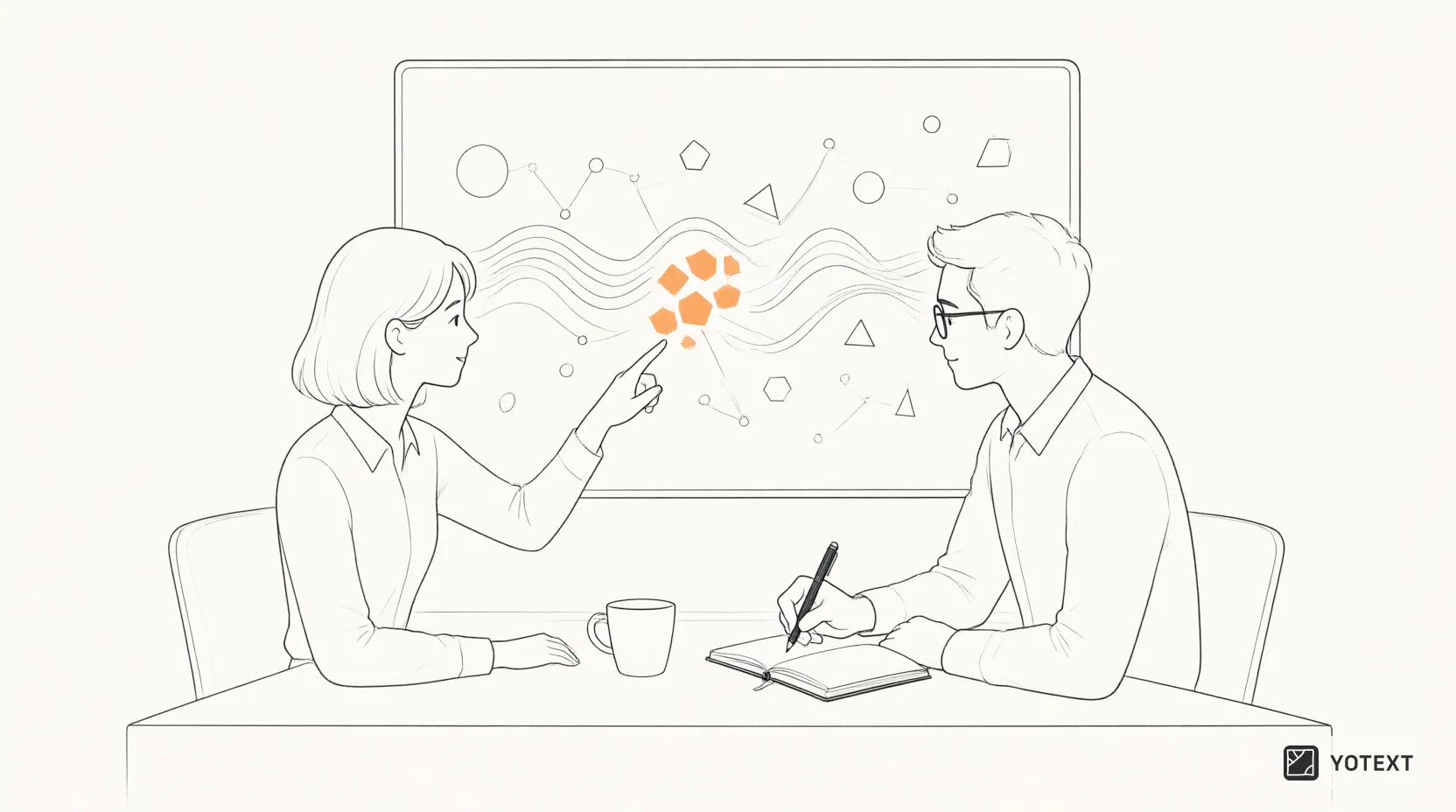
This tracing process becomes much more effective when supported by tools capable of identifying speakers and filtering key information. Instead of listening to audio recordings for hours, users can search for specific keywords or view automatically generated decision summaries. This transforms meetings from exhausting synchronous activities into asynchronous assets accessible anytime according to individual learning needs.
Mechanisms for Automating Knowledge Documentation
Relying on manual notes from meeting participants often results in incomplete documentation or bias toward the writer's perspective. To overcome this, meeting intelligence technology offers a more objective and comprehensive approach. YOTEXT works via an extension in the user's computer browser to record audio from the meeting tab and local microphone without requiring a bot to join as a participant. This approach ensures that recordings cover all voice interactions occurring in virtual spaces, including Google Meet, web-based Zoom, and web-based Microsoft Teams.
During the meeting, the extension panel displays live transcripts that can be shared via link. After the session ends, the system generates complete transcripts, summaries, lists of decisions, and action items along with owners and deadlines. The meeting memory search feature allows users to rediscover specific past conversations. For small teams, this means every brainstorming session or weekly review automatically contributes to the internal knowledge library without significant additional administrative burden.
Curation Strategies for Materials During the Initial Joining Phase
Although raw transcripts are very useful, new members might be overwhelmed by the volume of available information. Therefore, a simple yet effective curation strategy is needed. Managers or mentors can select several key meetings most representative of the team's work culture, such as the first sprint planning session, monthly product reviews, or post-incident discussions. Links to these meeting outcomes, whether summaries only or full results, can be included in the digital onboarding checklist.
It is important to distinguish between full access and limited access. Private meeting results are visible only to their owner, while the Team and Business plans provide a shared workspace for meeting results, tasks, and transcription quotas. In the context of onboarding, sharing revocable links provides flexibility in access control. If new members have completed specific learning modules, the link can be revoked or replaced with more complex material, ensuring that the learning flow remains structured and secure.
Reducing Dependence on Seniors Through Self-Service Learning
The main goal of transforming transcripts into guides is to empower new members to find answers themselves before asking others. When common questions such as 'why do we use this report format?' or 'who is responsible for vendor X?' can be answered by searching through meeting archives, the frequency of interruptions to seniors will decrease drastically. This improves time efficiency for all parties and encourages individual responsibility for one's own learning process.

The Q&A feature regarding specific meeting content strengthens this self-service aspect. New members can ask the system specific questions about the context of past decisions and receive answers based on available data. Although speaker identities are taken from captions and participant data when available, and neutral labels are used if identities are unclear, attribution accuracy helps new members understand each individual's role within the team without having to guess.
Privacy and Data Security Considerations
Opening meeting archives for onboarding purposes brings risks related to information confidentiality. Not all internal conversations are suitable for broad sharing, especially those involving sensitive client data or competitive strategies. Therefore, policies for sharing meeting results must be clearly defined. Users determine when recording starts and stops, providing full control over what is documented. Recordings are also kept secure if the browser closes suddenly or the network disconnects, and can then be resent, ensuring data integrity is not lost due to technical disruptions.
It should be acknowledged that YOTEXT does not yet have SOC 2 or ISO 27001 certification. For teams operating in heavily regulated industries, this becomes an important consideration in deciding whether all meeting archives can be made into open onboarding materials. Manual filtering may be required to remove sensitive sections before sharing links with new members, or access may be restricted only to meetings that are generally operational and do not contain confidential data.
Conclusion
Transforming meeting transcripts into onboarding guides is a strategic step to solve knowledge scalability problems in small teams. By leveraging tools like YOTEXT that automatically record, transcribe, and summarize discussions, organizations can turn ephemeral conversations into permanent and easily accessible intellectual assets. This process does not entirely replace human mentoring but complements interpersonal relationships with a strong foundation of facts and context.
The success of its implementation depends on consistency in recording and the willingness to share access in a controlled manner. When new members can trace decision history and understand team dynamics through objective data, their learning curve becomes smoother and the training burden on seniors decreases. Ultimately, teams that are able to document their own knowledge are more resilient, adaptive, and ready to face growth without sacrificing the quality of internal communication.