

Contents
In lean organizational structures, the boundary between leadership and supervision often becomes blurred. Leaders of small teams tend to feel the need to monitor every detail of work due to limited human resources. However, this approach actually creates a productivity paradox. The more intensively a manager engages in micromanagement, the lower team members' sense of ownership over their work results. As a result, initiative declines and dependence on superiors increases.
The solution to this problem does not lie in completely loosening control but rather in shifting the focus from activity supervision to expectation clarity. The key is information transparency. When every decision, the reasoning behind it, and task assignments are neatly recorded, the need to re-ask questions or micromanage decreases drastically. This is where meeting intelligence technology plays a crucial role in changing internal communication dynamics.
The Root Causes of Micromanagement in Small Teams
Micromanagement often stems not from bad intentions by leaders but from fear of uncertainty. In small teams, one person usually holds many responsibilities at once. A project manager might also handle client relations while a data analyst participates in strategic marketing discussions. The complexity of these dual roles makes it difficult for anyone to accurately remember what was agreed upon in various meetings throughout the week.

When the team's collective memory is not supported by a reliable recording system, information gaps emerge. Team members may doubt whether they have completed tasks according to expectations, while leaders feel anxious about whether their instructions were understood correctly. It is this misalignment of perception that triggers excessive supervisory behavior. Leaders feel the need to constantly check progress to ensure there are no interpretation errors, which ultimately burdens both parties' time.
The Digital Footprint as a Single Source of Truth
To break this cycle, organizations need to build what is called a single source of truth regarding business conversations. This means every important interaction must produce verifiable artifacts. Not just subjective handwritten notes, but objective records that can be reviewed at any time. With a complete digital footprint, debates about what was actually said can be minimized.
YOTEXT emerges as a solution to this challenge by transforming meeting recordings into structured knowledge assets. Through an extension in the computer browser, meetings held on Google Meet, Zoom web version, or Microsoft Teams web version can be recorded directly. This process is done without bots joining as participants, so it does not disrupt the flow of discussion. The extension records audio from the meeting tab and the user's microphone from their own browser. Users themselves determine when recording starts and stops, providing full control over privacy and conversation context.
From Raw Transcripts to Clear Action Items
Audio recordings alone are not enough to build accountability. The real value lies in transforming raw data into actionable information. After the meeting ends, YOTEXT automatically generates a complete transcript, summary of main points, list of decisions, and most importantly, action items along with owners and deadlines if mentioned in the discussion.
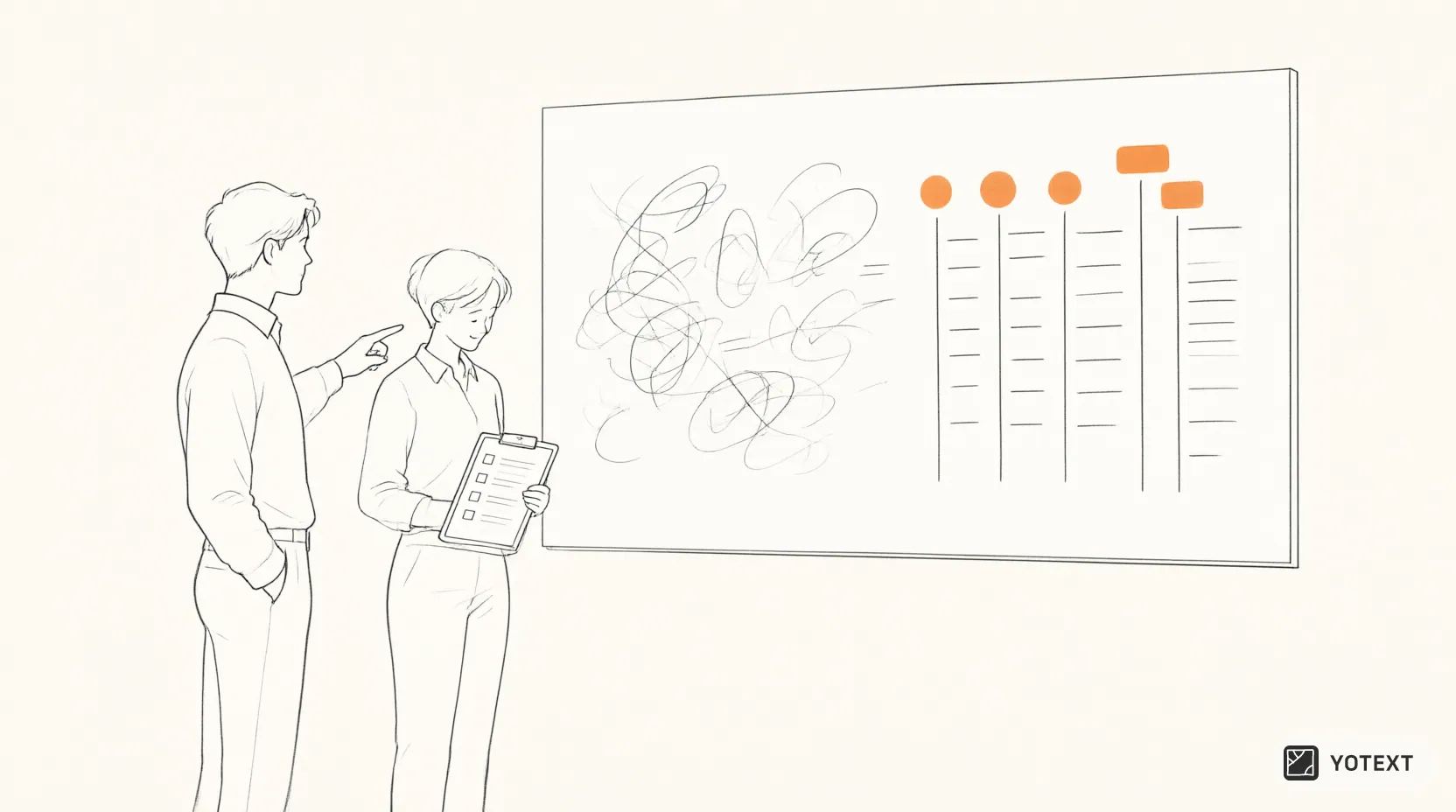
This process eliminates the cognitive burden on team members to remember specific details. Instead of spending time compiling manual minutes prone to bias or oversight, teams can immediately see who is responsible for what and when the deadline is. This clarity fosters a sense of ownership. When someone sees their name listed as a task owner in official post-meeting documents, positive social pressure to complete the task increases without needing to be reminded by superiors.
Reducing Ambiguity in Speaker Identity
One of the biggest hurdles in tracing back conversations is not knowing who spoke. In virtual meetings, voices often sound similar or become fragmented, especially if network quality varies among participants. If speaker identity is unclear, it is difficult to establish accountability for a statement or specific commitment.
The YOTEXT system addresses this by extracting speaker names from captions and meeting participant data when available. This metadata-based approach is more accurate than voice guessing. However, if identities are still unclear, the system uses neutral labels instead of guessing the origin of the voice. This principle of data honesty is important for maintaining team trust. No assumptions are made; only facts are presented. This prevents conflicts arising from misattribution of speech, which can damage collaborative dynamics.
Context Search and Organizational Memory
Accountability applies not only to ongoing tasks but also to learning from the past. Often, teams face similar problems repeatedly because they forget how they resolved them previously. Stored and searchable meeting histories allow team members to dig into the historical context of a decision. They can ask about specific meeting content to understand the background behind why Strategy A was chosen over Strategy B.
This search feature transforms meetings from one-off events into part of a living organizational memory. For small teams that frequently experience personnel changes or role rotations, the ability to access tacit knowledge from previous conversations is invaluable. Knowledge no longer disappears when key employees change roles or leave the company. Instead, insights remain available to all members of the shared workspace, whether in the Team or Business package, ensuring operational continuity.
Collaborative Correction and Data Security
Although automation helps efficiency, the human factor remains important for data accuracy. YOTEXT provides a collaborative correction mechanism. If multiple participants in the same meeting use YOTEXT, each person's speech can be corrected using the recording from their own microphone. This feature acknowledges that every individual has a unique perspective and the best access to the quality of their own audio. Thus, the final transcript becomes more accurate through collective verification rather than relying solely on a single algorithm.
Security and privacy are the foundation of trust when sharing sensitive information. Recordings are kept safe if the browser closes suddenly or the network disconnects, then can be resent for processing. Meeting results can be shared as full outputs or summaries only via links that can be revoked at any time. Private meetings are visible only to their owner, providing an additional layer of control for top management or discussions requiring high confidentiality. This security structure allows teams to be open in discussion without fear of information leaking to unauthorized parties.
Transparency Mechanisms During Ongoing Meetings
True accountability does not wait for the meeting to end. During the discussion session, the extension panel displays a live transcript. Participants can see the words captured in real-time. This allows for instant clarification if there are misunderstandings regarding technical terms or target figures. That live transcript can be shared via link with absent colleagues or other stakeholders who need immediate updates without having to wait for formal minutes.
The ability to share this live transcript reduces the need for long and often delayed follow-up emails. Information flows synchronously with the conversation. In the context of small teams where response speed is vital, this feature ensures all parties move based on the same data at the same time. This is a practical step to minimize the time lag between decision and execution.
Cross-Meeting Task Integration in a Single List
Another challenge in small teams is task fragmentation. Someone might have three action items from the morning meeting, two from the afternoon meeting, and one from the evening meeting. Tracking everything separately easily leads to oversight. YOTEXT collects tasks from various meetings into a single task list. This provides a holistic view of individual workload without needing to open many different application windows.

With a centralized task list, leaders can objectively see workload distribution. If one person has too many items with the same deadline, the leader can intervene early for task redistribution. This is not micromanagement but data-driven capacity management. The practical step is to review this task list periodically to ensure priorities align with the team's strategic goals.
Conclusion
Building a culture of accountability without micromanagement requires a paradigm shift in managing meeting information. Leaders must shift from the role of activity supervisors to facilitators of clarity. By leveraging tools like YOTEXT, small teams can transform ordinary conversations into strategic assets that support independent and responsible task execution.
Transparency through the digital trail of meeting decisions reduces ambiguity, accelerates new member onboarding, and minimizes conflicts due to miscommunication. Ultimately, when everyone has equal access to agreed-upon facts and commitments, mental energy can be redirected from monitoring processes to innovation and solving real problems.