
Contents
Tension in small teams often does not stem from major wrong decisions, but from minor misunderstandings left to settle. In crowded meeting rooms, the boundary between what someone truly said and how that speech is interpreted by others becomes very thin. When memories start to fade or personal biases enter post-meeting discussions, a neutral sentence can turn into a sharp accusation.
The main problem in internal negotiations is not just the content of the conversation, but the team's inability to accurately refer back to the original context. Without clear written evidence, each party tends to maintain their own version of the narrative. This creates a vicious cycle where objective facts are obscured by subjective interpretations, causing conflicts that should have been resolved quickly to develop into long-term friction that damages team cohesion.
Human Memory Vulnerability in Intense Discussions
The human brain is designed to store meaning, not exact words. After a meeting ends, participants tend to remember the core message or feelings that emerged during the discussion, while specific details such as the order of arguments or language nuances are often lost or distorted. In tense negotiation situations, this distortion is exacerbated by emotions. A team member might feel attacked because of a colleague's tone of voice, then recall it as an attack on character, even though the conversation focused only on technical issues.
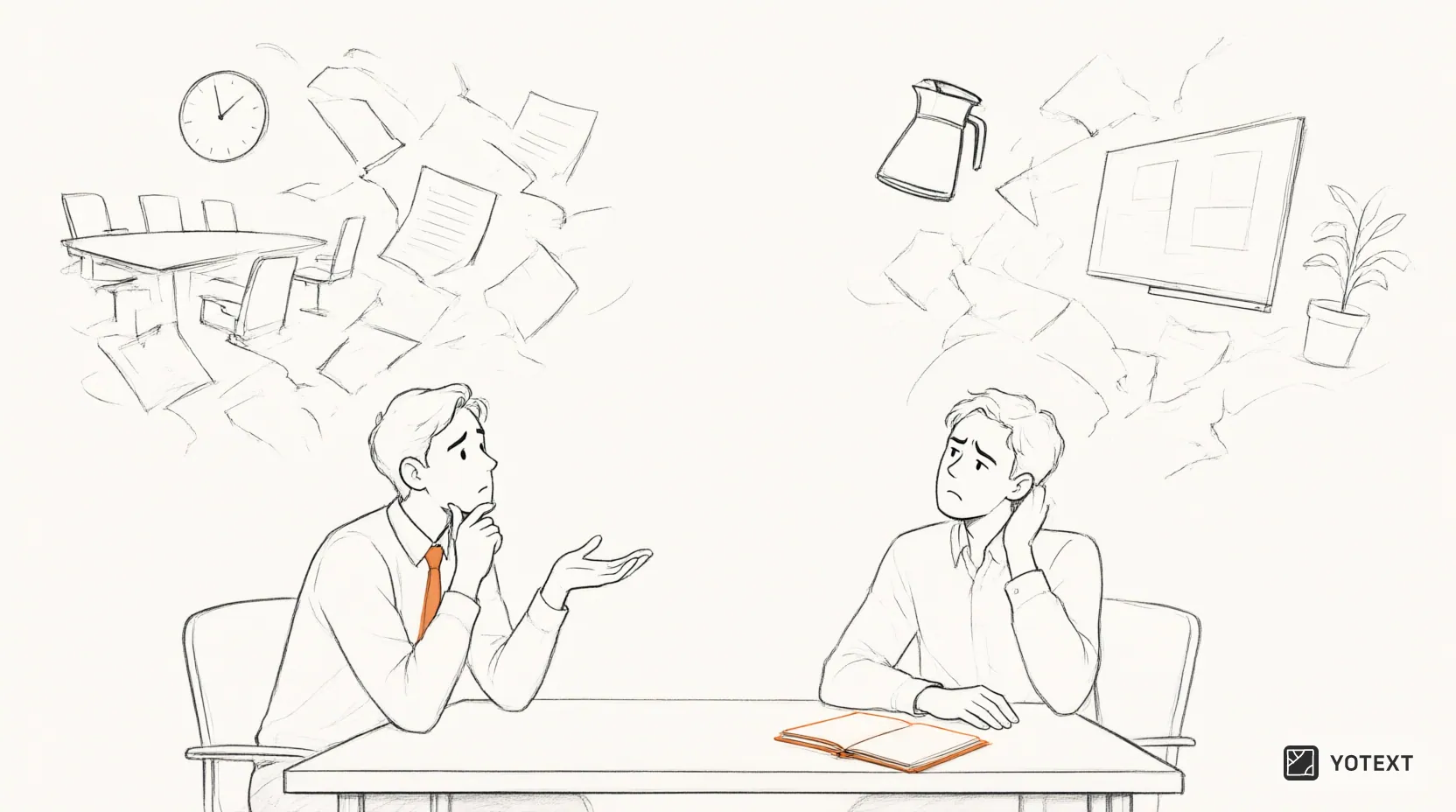
When two people remember different versions of the same conversation, the subsequent confrontation will begin from different starting points. There is no agreed-upon common reference. As a result, the discussion shifts from problem-solving to debating who remembers the event more accurately. This is a classic trigger for conflict escalation, where each party's ego is hurt because they feel unheard or misunderstood.
Redefining the Role of Transcripts as Neutral Anchors
Meeting transcripts function most effectively when viewed as neutral anchors, rather than merely administrative notes. The goal is to provide a layer of reality that can be verified by all parties. By having the full text of the conversation, teams can stop guessing what was meant and start analyzing what actually happened. This changes the dynamic from 'in my opinion' to 'based on the record'.
However, raw transcripts alone are not enough if used incorrectly. Many teams get stuck re-reading entire dialogues without structure, which takes time and still leaves room for wild interpretations. The solution lies in a strict separation between direct quotes (facts) and summaries or analyses (interpretations). When these two elements are presented separately, readers can see which parts are raw data and which are conclusions drawn from that data.
Distinguishing Factual Statements from Personal Opinions
The first step in preventing conflict is training the ability to distinguish types of statements in transcripts. Factual statements usually contain data, dates, numbers, or concrete actions that have been done or planned. Example: 'Project A finished on Friday.' Conversely, opinion or interpretation statements contain adjectives, adverbs, or subjective claims. Example: 'Project A finished late and disappointingly.'

In internal negotiations, conflicts often erupt when opinions are wrapped as if they were facts. If a manager says 'Your team is unresponsive,' that is a subjective interpretation of certain behavior. However, if the transcript shows that the team answered emails within an average of four hours, then the objective fact is the response time, not the label 'unresponsive'. By separating the two, teams can discuss acceptable response time standards, instead of arguing about performance perceptions.
Using Conversation Context to Clarify Intent
One of the biggest sources of misunderstanding is the loss of context. A short sentence that sounds rude might actually be a response to an ambiguous question or high time pressure. Good transcripts capture the flow of conversation, allowing readers to see stimuli and responses sequentially. This helps identify whether tension stems from the message content or from the interaction dynamics at that moment.
For example, if a team member interrupts the conversation, subjective interpretation might view it as rudeness or dominance. However, if the transcript shows that the interruption occurred after the previous speaker provided information contradicting recently presented data, then the interruption can be seen as an urgent corrective effort rather than a personal attack. Recognizing these patterns helps teams assess the intent behind actions, not just their emotional impact.
The Role of Speaker Identification in Accountability
Conflicts often worsen when responsibility for a statement becomes blurred. Who proposed this idea? Who rejected that option? Without clear speaker identification, teams tend to blame groups or individuals who were not involved. Systems capable of linking speech to specific identities through captions or meeting participant data help clarify each party's position.
It is important to note that identification must be based on available data, not guesses. If identity is unclear, using neutral labels is better than making incorrect assumptions. Errors in speech attribution can trigger unnecessary new conflicts. By ensuring that every statement is linked to the correct speaker, teams can conduct fair reflections. Team members can objectively review their own contributions and understand how their positions compare with those of their colleagues during discussions.
Practical Strategies for Reading Transcripts Post-Conflict
When tension has already arisen, a reactive approach to transcripts should be replaced with analytical methods. Instead of seeking evidence to justify one's own position, the primary goal is to identify points of divergence between facts and interpretations. Start by isolating the parts of the conversation that triggered the conflict. Re-read direct quotes from both sides without adding mental commentary.

Next, compare those quotes with the summaries or action items generated. Is there a gap between what was said and what was recorded as decisions? Often, conflicts arise because one party feels their voice was not reflected in the final outcome. By verifying recording accuracy, teams can improve decision-making processes, not just resolve momentary disputes. This builds trust that the recording system works for collective benefit, rather than serving as a tool for unilateral surveillance.
Integrating Meeting Intelligence Technology into Team Culture
Technology that converts audio recordings into transcripts, summaries, and task lists can become an effective mediator if adopted with the right culture. Search features within meeting history allow team members to find precedents of similar decisions in the past. This reduces the need to re-debate fundamental organizational principles, as historical answers are already available and accessible.
Using live transcript panels during meetings also aids real-time clarification. If there is ambiguity in speech, participants can immediately request repetition or explanation before the meeting ends. This prevents the accumulation of misunderstandings that would otherwise take days to untangle later. Additionally, the ability to share revocable links to meeting results gives meeting owners control over who has access to sensitive information, maintaining privacy while supporting necessary internal transparency.
Recording Mechanisms and Data Privacy
Trust in transcripts as a neutral anchor depends on understanding how the data is obtained. YOTEXT records meetings via an extension in the user's own computer browser for platforms such as Google Meet, the web version of Zoom, and the web version of Microsoft Teams. This process does not involve bots joining as meeting participants, so the recorder's presence does not alter the room's social dynamics.
The extension records the audio from the meeting tab and the user's microphone from their own browser. Users retain full control over when recording starts and stops. This aspect of manual control is crucial in conflict contexts because it affirms that transcripts are created based on active consent, not covert surveillance. Transparency about this mechanism helps reduce paranoia that a third party is monitoring without permission, which often fuels additional interpersonal tension.
Cross-Verification for High Accuracy
Despite advanced technology, transcription errors remain possible, especially if audio quality is poor or accents are difficult to recognize. To address this, YOTEXT offers collaborative correction features. If multiple participants in the same meeting use YOTEXT, each person's speech can be corrected using recordings from their own microphone. This means if one person mishears or misrecords something, other participants can validate or amend the entry based on their local audio sources.
This feature is highly relevant in conflict situations where one party claims they never said something. With cross-correction options, teams can reach consensus on what was actually spoken. The end result is a more accurate transcript accepted by all. Furthermore, recordings are kept safe if the browser closes suddenly or the network disconnects, allowing them to be resent. This system resilience ensures that conversational evidence is not lost due to technical glitches, which often serve as excuses for guilty parties to deny their involvement.
Conclusion
Preventing conflict escalation in small teams does not require changing team members' personalities, but rather improving communication and verification mechanisms. By making meeting transcripts the objective source of truth, teams can systematically separate facts from subjective interpretations. This process reduces the cognitive load of remembering details and eliminates room for personal bias to dominate discussions.
Ultimately, the true value of meeting intelligence lies not in automating note-taking, but in its ability to create clarity. When every team member can refer to accurate, searchable, and structured notes, internal negotiations become more rational and less emotional. Decisions are made based on conversation data rather than vague perceptions, thereby increasing accountability and maintaining working relationships even when disagreements occur.