

Contents
Many business professionals feel their workdays are consumed by meetings that yield no tangible actions. The main problem is often not a lack of ideas, but rather the mixing of creative processes with decision-making processes. When brainstorming sessions are conducted simultaneously with setting deadlines and assigning task owners, participants' brains are forced to switch rapidly between free exploration mode and critical evaluation mode. This context switching creates high cognitive load, resulting in lower idea quality and blurred accountability.
A practical solution to this problem is to strictly separate idea-gathering sessions from execution sessions. In this new structure, meeting transcripts serve as an objective filtering tool. Instead of relying on fragile collective memory or biased manual notes, business professionals can use conversation recordings to distinguish which parts are creative speculation and which are work commitments. Meeting intelligence technology like YOTEXT enables this separation to occur naturally because every spoken word is recorded and can be re-categorized after the meeting ends.
The Dangers of Mixing Creative Mode and Evaluative Mode
In the dynamics of both small teams and corporations, there is constant tension between the need for innovation and the demand for operational efficiency. When a leader asks their team to brainstorm solutions for declining sales while simultaneously demanding a concrete action plan before the meeting ends, participants experience role confusion. They do not know whether they should dare to propose crazy ideas or ensure those proposals are realistic and easy to execute next week.
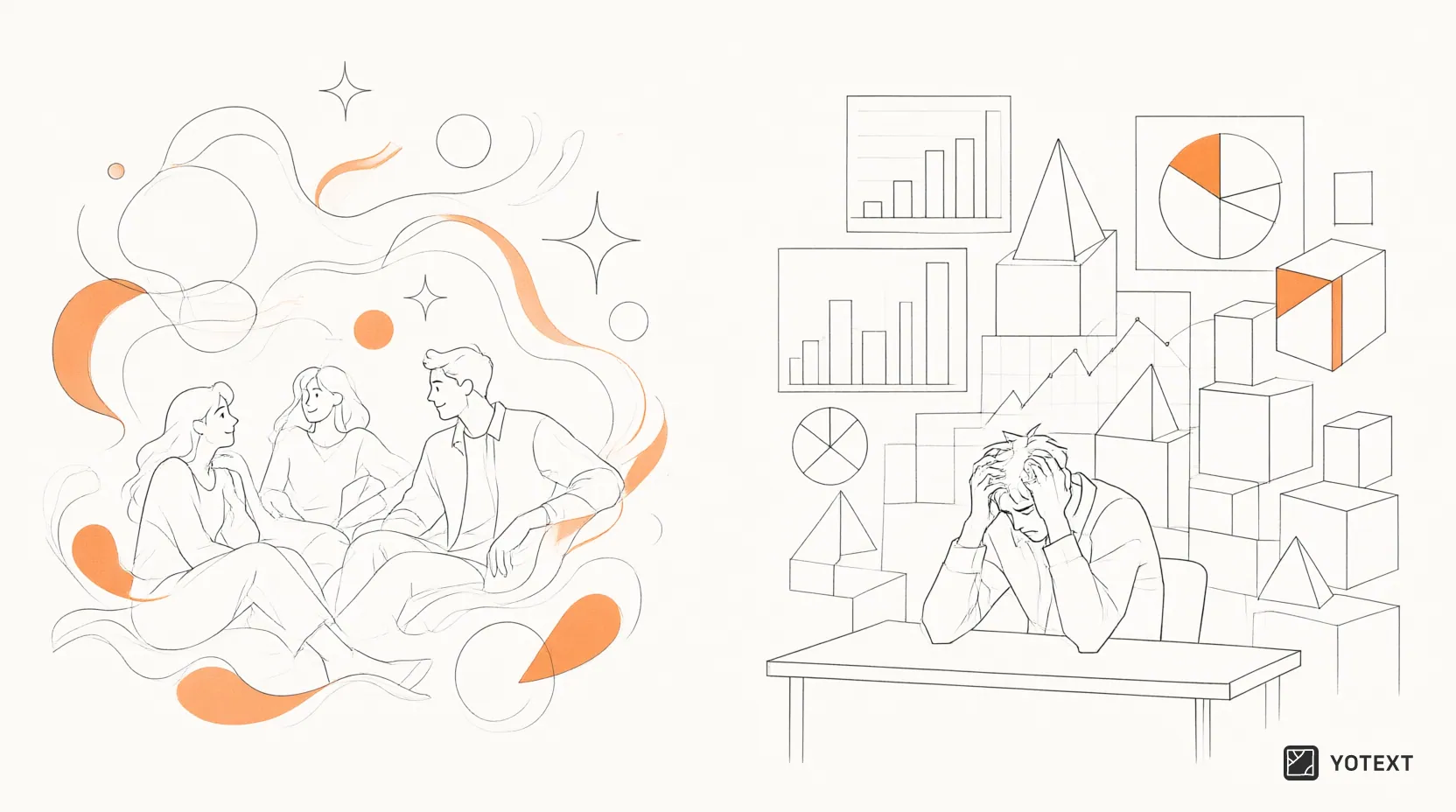
A side effect of this mixing is the dominance of vocal voices. More senior or confident participants tend to dominate discussions because they already have ready-made answers, while junior or introverted participants hold back for fear their ideas will be judged poorly immediately. As a result, organizations lose potential creative solutions that might actually be more effective, simply because the evaluation process was too early and integrated with execution pressure.
Anonymous Brainstorming as a First Step
One technique proven effective in overcoming hierarchy bias is collecting ideas anonymously first. Before entering the open discussion stage, each team member is given five to ten minutes to write down their ideas without mentioning the author's name. This method shifts the focus from who is speaking to what is being discussed. Ideas that might seem trivial if spoken by a junior could be well-received if read as neutral text.

However, challenges arise when these written ideas must be discussed and filtered. If the facilitator reads out ideas one by one without technological assistance, the process takes time and is prone to misinterpretation. This is where digital documentation becomes crucial. With complete transcripts from initial or preliminary sessions, teams can refer back to nuances in speech that might be lost in brief notes, ensuring that idea filtering is based on intact conversation data, not fragments of memory.
Transcripts as an Objective Filter Post-Meeting
After the brainstorming session ends, the real work for business professionals is turning piles of raw ideas into an accountable list of actions. Without a clear system, this transition often fails due to human memory limitations. YOTEXT exists as a meeting intelligence solution that records audio tabs from the user's own browser, whether in Google Meet, web-based Zoom, or Microsoft Teams. Importantly, no bot joins as a participant. The extension works silently on the user's side, providing full control over when recording starts and stops.
During the meeting, the extension panel displays live transcripts that can be shared via link. This feature allows participants to stay focused on the discussion without needing to busy themselves with note-taking. After the meeting ends, YOTEXT generates a complete transcript, summary, decisions, and action items along with owners and deadlines if mentioned. This process acts as the filter. Business professionals can review the transcript to distinguish between speculative sentences ("What if we try...") and commitment-oriented sentences ("I will handle this part...").
Phase Separation Mechanism in the YOTEXT Workflow
The main advantage of the transcript-based approach is the ability to treat meeting data modularly. Meeting history is stored and searchable, allowing business professionals to reopen old brainstorming sessions without disrupting the current execution workflow. Tasks from various meetings are collected in a single task list, so unexecuted ideas are not lost buried under other priorities.
For teams working collaboratively, YOTEXT's Team and Business plans provide a shared workspace for meeting results, tasks, and transcription quotas. This means all team members can access the same transcripts and correct speaker identities if necessary. Speaker names are taken from captions and meeting participant data when available. If identities are unclear, YOTEXT uses neutral labels rather than guessing, ensuring data integrity is maintained throughout the idea filtering process.
Accountability Without Micromanagement
When decisions and action items have been filtered from the transcript and clearly defined, managers no longer need to micromanage. Accountability shifts from constant supervision to responsibility toward an objective shared record. If an employee claims they were never assigned a task, the full transcript can serve as definitive evidence. Conversely, if an employee feels their task does not align with the discussion, they can refer to specific quotes in the transcript.
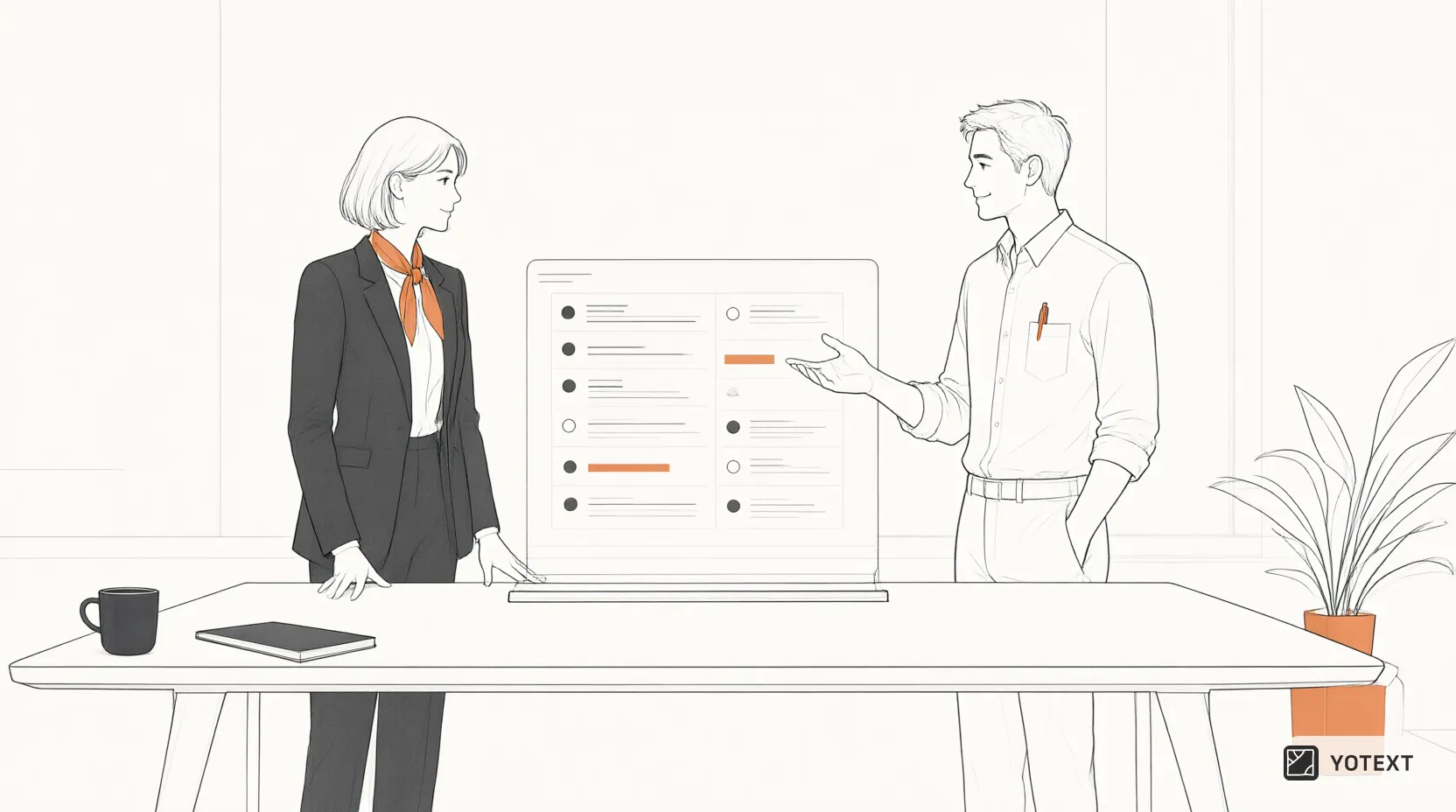
Recordings remain secure even if the browser closes suddenly or the network disconnects, allowing them to be resent. This technical stability ensures that no information gaps occur due to technological disruptions. Meeting results can be shared as complete outputs or summaries only via revocable links. Private meetings are visible only to their owner, providing an additional layer of security for sensitive business strategies during the idea filtering phase.
Practical Implementation for Business Owners
The first step for business owners wanting to implement this method is to change meeting culture. Set clear agendas: the first session dedicated solely to idea collection without criticism, and the second session dedicated to evaluation and assignment. Use YOTEXT to record both sessions. Extensions are available for Chrome and Edge, and the app supports Indonesian, English, and Mandarin, making it suitable for multinational or local teams.
After the meeting, use the feature to ask questions about specific meeting content to uncover details that may have been missed. For example, you can ask the system about all proposals related to "pricing strategy" that emerged during the brainstorming session. The system will present relevant quotes from the transcript. From there, you can create a clean execution checklist, separated from the noise of unselected ideas. The app can be opened from computers or mobile phones, facilitating post-meeting reviews wherever you are.
Conclusion
Separating brainstorming sessions from execution sessions is not just about time management, but about the cognitive health of the team. By removing the pressure to make immediate decisions while ideas are still raw, business owners open space for more honest and diverse creativity. However, this separation is only effective if supported by accurate and easily accessible recording infrastructure.
YOTEXT offers the right mechanism to bridge the gap between verbal conversations and operational execution. Through automatic transcripts, decision summaries, and centralized task lists, business owners can filter ideas objectively without losing context. Ultimately, true productivity arises not from how many meetings are held, but from how clear the boundary is between thinking and acting.
Sources
https://www.lemon8-app.com/@tipsbydgm/7518806682706002440?region=id
https://klc2.kemenkeu.go.id/kms/knowledge/teknik-brainsorming-4eff7c4f/detail