
Contents
In corporate operational cost calculations, time spent on administration is often overlooked. Yet, manually drafting meeting minutes is a form of invisible labor that drains high-quality human resources. When a project manager or business analyst spends two to three hours after an important meeting retyping discussions, marking decisions, and distributing tasks, they are not performing strategic analysis or technical execution. They are doing transcription.
The paradigm shift in team knowledge management requires us to view automation tools not merely as conveniences, but as instruments of financial efficiency. By adopting technology like YOTEXT, organizations can free up employees' cognitive capacity from the burden of repetitive note-taking. This article will outline how to measure the Return on Investment (ROI) of transcript automation by calculating the work hours successfully saved, and how this directly impacts documentation accuracy and follow-up speed.
Hidden Costs of Manual Note-Taking
Many businesses still rely on conventional methods where one person is designated as the official scribe, or worse, every participant takes their own version of notes which then must be synchronized. The main problem with this approach is inconsistency and the risk of losing context. When someone focuses on writing word for word, active participation in the discussion decreases. Conversely, if notes are made from memory after the meeting ends, critical details such as negotiation nuances or reasons behind rejecting an idea are often lost.
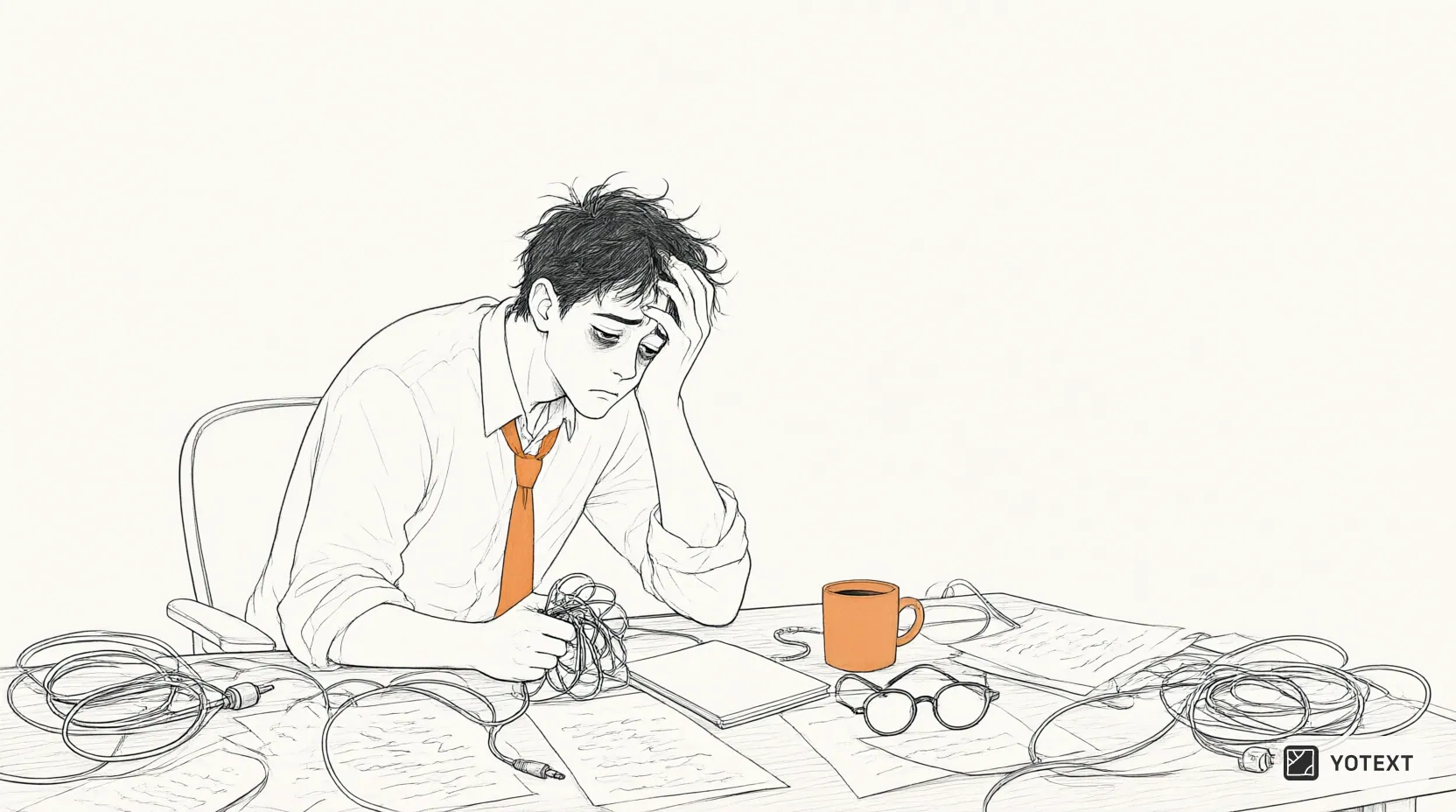
From a productivity standpoint, the time required to review raw audio recordings or read handwritten scribbles is significant. If a team holds five weekly meetings averaging one hour each, and needs a total of three hours to compile a neat final document, then fourteen work hours per week are allocated solely to meeting administration. This figure does not yet include the time spent searching for old information when disputes arise or confusion occurs regarding who is responsible for specific tasks.
Recording Mechanism Without Disrupting Participation
Modern solutions offer a different approach to this problem. YOTEXT works as meeting intelligence that transforms meeting recordings into structured data assets. Its key advantage lies in how recording is conducted. No bot joins the meeting as an additional participant, so the social and psychological dynamics of the virtual space remain intact. Browser extensions for Chrome and Edge record the meeting tab's audio and the user's microphone directly from the local computer.
This process gives users full control over when recording starts and stops. During the meeting, the extension panel displays a live transcript that can be shared via link. This allows participants who fall behind or have connection issues to keep up with the conversation flow without needing to ask for repetitions. Speaker identification is taken from captions and participant data if available. If identities are unclear, the system uses neutral labels rather than guessing, maintaining data integrity from the start.
Transforming Raw Data into Written Decisions
The true value of automation does not stop at text transcription alone. After the meeting ends, YOTEXT generates summaries, decision lists, and action items along with owners and deadlines. This is the stage where saved work hours are most felt. Manually, a scribe must sort out what constitutes ordinary opinion sharing versus formal commitments. This machine performs that sorting automatically based on conversation patterns.
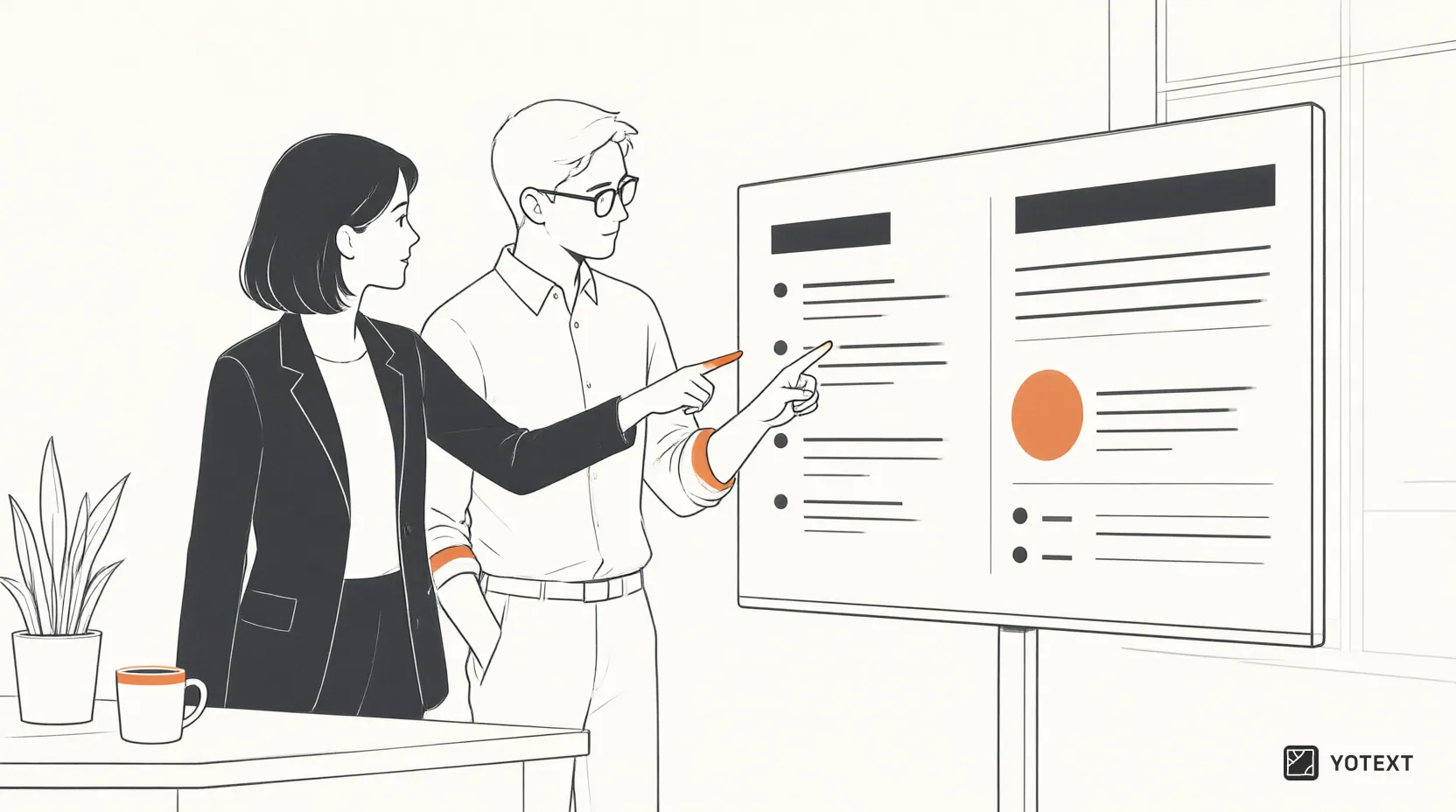
Users can also query the content of specific meetings through the search interface. Meeting history is stored and searchable, creating durable organizational memory. Tasks from various meetings are collected in one centralized task list. Imagine the impact of time savings when a manager no longer needs to open ten different Word files to check project status, but instead simply views one task dashboard updated in real-time from the latest meeting results.
Collaborative Accuracy and Data Security
One common skepticism towards AI transcription is its accuracy. However, collaborative features in YOTEXT address this in a unique way. If multiple participants in the same meeting use YOTEXT, each person's speech can be cross-corrected using recordings from their respective microphones. If one person hears the word 'budget' while another hears 'bugged', the system can leverage differences in audio quality from the two sources to determine the most likely correct word. This improves accuracy without requiring time-consuming post-meeting human intervention.
From a security perspective, recordings are kept safe even if the browser closes suddenly or the network disconnects, and can then be resent. Meeting results can be shared as full outputs or summaries only via links that can be revoked at any time. Private meetings are visible only to their owners. The Team and Business packages provide a shared workspace for meeting results, tasks, and transcription quotas, ensuring that knowledge assets remain under organizational control.
A Simple Formula for Calculating Automation ROI
To measure financial gains, use a simple formula: Total Hours Saved multiplied by Employee Hourly Cost. Assume a senior professional has an effective salary cost of Rp 100,000 per hour. If a team consists of five people and they usually spend 30 minutes each taking notes and tidying up minutes after a one-hour meeting, the total wasted time is 2.5 hours per session. With YOTEXT, this time is drastically reduced because transcripts and summaries are available immediately after the meeting ends.

If the meeting frequency is 10 times a month, time savings reach 25 hours. Multiplied by the hourly cost, the monthly savings value is Rp 2,500,000 per team member. This figure does not yet include qualitative benefits such as reduced communication errors, increased accountability due to clearly recorded action items, and the ability to retrieve past decisions in seconds. ROI becomes positive even before considering potential lost revenue due to delayed task execution.
When Is a Business Ready to Switch to Automation?
Not all organizations need complex solutions from day one. Signs of readiness include high meeting frequency, long discussion durations, and difficulty tracking agendas after meetings end. If teams often spend time reviewing meetings or lack time to compile minutes, it is a strong signal that manual processes have become a bottleneck. Decreasing consistency in documentation also indicates that manual standards are no longer adequate for growing operational scale.
YOTEXT supports applications in Indonesian, English, and Mandarin, and can be accessed from computers or mobile phones to view results, although recording is done via extension on the computer. Free, Pro, Team, Business, and Enterprise packages are available and can be tailored to team size needs. It is important to note that YOTEXT does not yet have SOC 2 or ISO 27001 certification, so for industries with super strict data regulations, internal evaluation of additional security protocols may be necessary before mass adoption.
Conclusion
Calculating transcript automation ROI is not just about saving money, but about reallocating the most valuable asset in business: human attention. By eliminating the burden of manual note-taking, teams can focus on what truly matters—strategic discussions, innovation, and execution. YOTEXT offers an honest and transparent mechanism to achieve this, turning voice archives into searchable and verifiable action guides.
The decision to switch from manual minutes to meeting intelligence should be based on calculations of work hours wasted thus far. When time savings begin to cover subscription costs, and when documentation accuracy begins to reduce internal conflicts due to miscommunication, automation is no longer a choice, but an operational necessity. Start by evaluating one small team, measure the impact, and see how work culture shifts from reactive to proactive thanks to always-ready meeting data.
Sources
https://miitel.com/id/6-tanda-bisnis-anda-butuh-ai-notulen-rapat/