

Contents
Many teams spend working hours in meetings that feel productive while they are happening, yet the results evaporate as soon as participants leave the room or close their browser tabs. Long discussions about product strategy or service improvements often fail to produce real change because key decisions are not recorded with precision. The main issue is not a lack of good intentions among participants but rather the gap between verbal conversation and operational execution.
The solution to this gap lies in structuring information after the meeting. When raw transcripts are turned into action checklists with clear owners and specific deadlines, accountability shifts from fragile collective memory to an objective recording system. Meeting intelligence technology now enables this process to happen automatically, ensuring that every word spoken in a meeting can be traced back to concrete work steps.
The Danger of Ambiguous Post-Meeting Decisions
When meetings rely only on manual notes or participant memory, interpretations of what was agreed upon often vary. A manager might feel they have assigned a design revision to a designer, while that designer records it as a request for initial consultation. These definitional mismatches create internal friction and delay project progress. Without neutral and accurate documentation, meetings become echo chambers where personal assumptions dominate over collectively agreed facts.

The impact of this ambiguity extends throughout the organization. Critical projects stall not due to a lack of resources but because of unclear responsibility for the next step. In both small teams and large corporations, the loss of an audit trail for a decision makes performance evaluation subjective. As a result, a healthy work culture is replaced by blame-shifting when targets are missed because no party holds written evidence of commitments made during the discussion.
Recording Mechanisms That Do Not Disrupt Participation
Traditional approaches to documenting meetings involve appointing a dedicated note-taker or using AI bots that join as virtual participants. Both methods have fundamental weaknesses regarding privacy and social dynamics. Human note-takers break focus, while the presence of a bot in a meeting can make participants feel monitored, thereby inhibiting openness of ideas. YOTEXT offers an alternative through a browser extension that works on the user's side without sending foreign entities into Google Meet, Zoom web version, or Microsoft Teams web sessions.
This extension records audio from the meeting tab and the user's microphone directly on the local computer. This process gives users full control over when recording starts and stops. During the meeting, the extension panel displays a live transcript that can be shared via link if needed. Speaker identification is based on captions and available participant data; if identity is unclear, the system uses neutral labels instead of guessing names, thus maintaining objectivity of the notes from the data collection stage.
Transforming Raw Data into Structured Action Items
The core value of meeting intelligence does not lie merely in storing conversation text but in extracting meaning. After the meeting ends, YOTEXT processes the recording to generate a complete transcript, summary, list of decisions, and most crucially, action items. Each identified task is equipped with a responsible owner and deadline according to details mentioned in the discussion. This turns long narratives into ready-to-execute work units.

This process minimizes administrative burden for teams. Instead of spending hours reorganizing notes from scratch, team members can immediately view categorized task lists. The meeting memory search feature allows users to ask about the content of specific past meetings, for example, asking about the reason behind delaying a certain feature or technical specification details agreed upon last week. Thus, transcripts are no longer dead archives but active knowledge bases supporting continuous decision-making.
Integrating Tasks Across Meetings in One Workspace
One of the biggest challenges in project management is information fragmentation. Tasks are often scattered across various chat platforms, emails, and separate documents. The Team and Business packages on YOTEXT provide a shared workspace where meeting results, tasks, and transcription quotas are gathered in one place. Meeting history is stored neatly and searchable, while tasks from different meetings are automatically consolidated into one global task list.
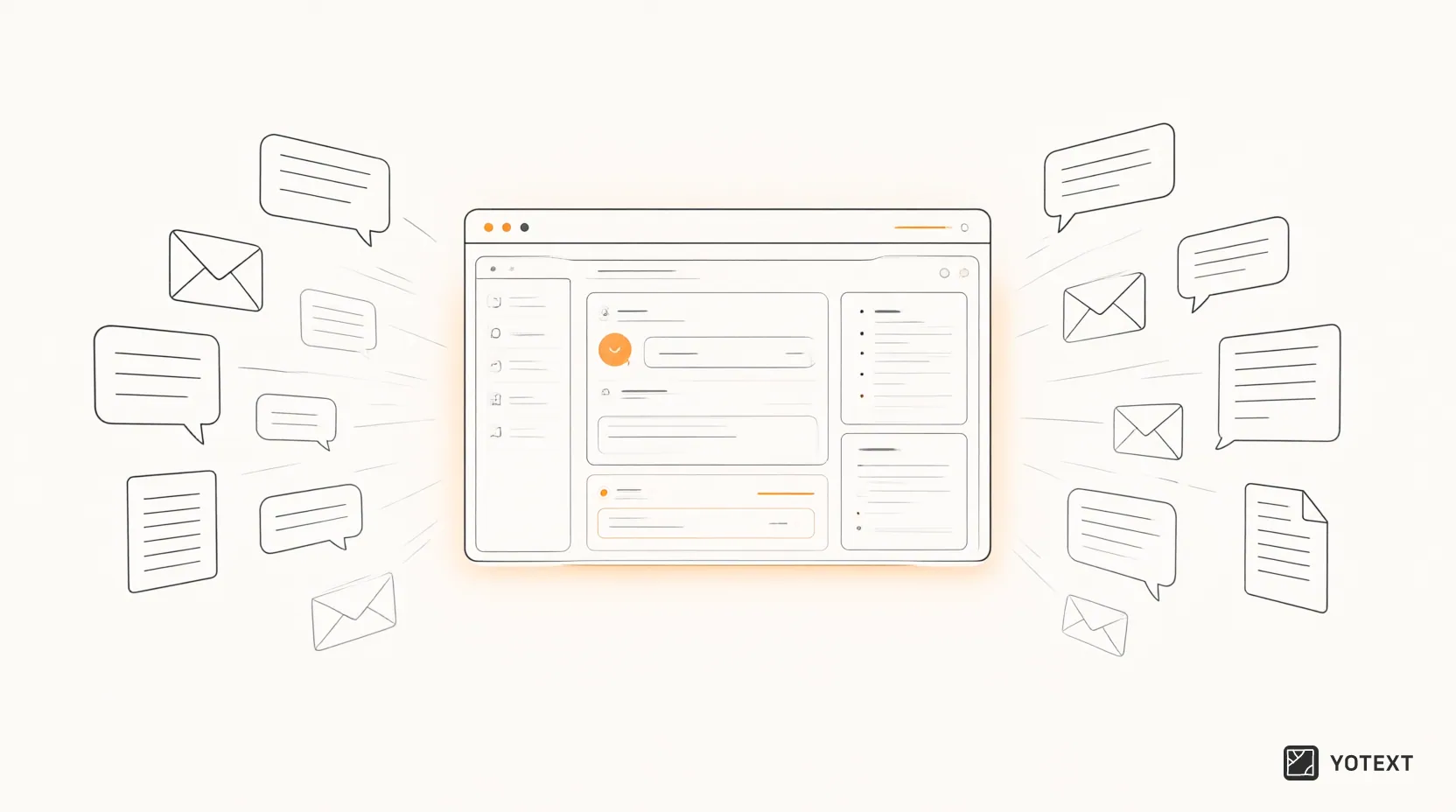
This consolidation makes it easier for managers to monitor the workload of individuals and teams. When an employee opens their dashboard, they do not need to recall which meetings they attended to determine the priorities for the day. All relevant action items appear in a single interface. This reduces the risk of tasks being lost or forgotten because they are buried in chat threads that have sunk out of view. This transparency also encourages healthier collaboration, as every team member can see the context of their colleagues' work without needing to micromanage.
Collective Accuracy Through Joint Corrections
Although transcription technology is becoming increasingly sophisticated, voice identification errors or mishearings remain possible, especially in environments with many speakers or diverse accents. YOTEXT addresses this through a participation-based correction mechanism. If several participants in the same meeting use YOTEXT, each person's speech can be corrected by referring to the audio recordings from each user's microphone. This creates an additional layer of validation that improves the final accuracy of the document.
This feature is particularly useful in cross-border meetings or multinational teams. The application is available in Indonesian, English, and Mandarin, allowing meeting results to be accessed from both computers and mobile phones. Recording is indeed done on the computer via the extension, but the accessibility of results on mobile devices ensures that task monitoring and note verification can be performed anywhere. Data security is also maintained with protocols that ensure recordings remain safe even if the browser closes suddenly or the network disconnects, thanks to automatic resend capabilities once the connection is restored.
Practical Decisions: Building a Culture of Automatic Documentation
Adopting tools like YOTEXT requires a change in habits, not just software installation. The first step is to establish a rule that every meeting resulting in decisions must be documented through this system. Users must get into the habit of starting the recording exactly when the meeting begins and stopping it when the official session ends. Meeting results can be shared as complete documents or summaries only via revocable links, providing flexibility in sharing sensitive versus general information.
It is important to remember that YOTEXT is an aid, not a replacement for leadership. Meeting leaders must still facilitate discussions to ensure clear objectives. However, with the safety net of automatic transcripts and action item extraction, leaders can focus more on group dynamics and idea quality rather than worrying about losing technical details. It is this combination of empathetic human facilitation and objective machine recording that forms an efficient execution cycle with minimal friction.
Technical Limitations and Privacy Considerations
Users need to understand the technical limitations of the extension-based recording system. Since recording is captured from the client-side browser, audio quality heavily depends on the local microphone and the stability of the user's internet connection. If a participant experiences severe network issues, the transcript portion from that participant may not be saved perfectly, although YOTEXT has a data resend mechanism when the connection recovers. Therefore, it is recommended to always check the completeness of the transcript immediately after the meeting ends before distributing it.
From a security standpoint, YOTEXT does not yet have SOC 2 or ISO 27001 certification. Organizations operating in sectors with very strict data regulations, such as finance or healthcare, must evaluate whether storing data in YOTEXT's cloud meets their internal compliance standards. Although private meetings are visible only to the owner and links can be revoked, corporate data governance policies must still be adjusted according to the current certification status.
Phased Implementation Steps for Teams
YOTEXT implementation should be carried out in phases to avoid resistance to change. Start with a pilot project in one small team that holds regular weekly meetings. Use the Free or Pro package to test basic workflows, from activating the extension to sharing summary links. Record how much time is saved in compiling manual minutes compared to YOTEXT's automated review process.
Once the team is accustomed, switch to the Team or Business package if you require a shared workspace. Here, added value emerges when tasks from various meetings are aggregated into a single list. Ensure all team members understand that speaker identities are taken from the meeting captions. If captions are inactive or inaccurate, use the neutral labels provided by the system and perform manual corrections if necessary. Do not let ambiguity in speaker names persist, as it will undermine the accountability of action items.
Maximizing the Value of Meeting Memory
The meeting memory search function is a strategic asset that is often overlooked. Instead of storing static PDF or Word files, use YOTEXT's Q&A feature to dig up historical context. For example, during monthly meetings, you can ask:
What was our last decision regarding the Q3 marketing budget?
The system will retrieve answers from previous meeting transcripts. This accelerates the onboarding of new members because they can access the logic behind decisions without having to read hundreds of pages of minutes.
To maintain memory relevance, ensure meeting metadata is filled out correctly when uploading other recordings or initiating recordings via the extension. Descriptive meeting titles help the algorithm group topics. Additionally, use the joint correction feature if other participants are also using YOTEXT to improve speaker attribution. The more accurate the input data, the higher the team's trust in the generated action item output.
Strategic Conclusion
The effectiveness of a meeting is not measured by how long the discussion lasts, but by how quickly and accurately ideas are transformed into concrete actions. By converting transcripts into action checklists with specific owners and deadlines, organizations eliminate the ambiguity that often causes execution to stall. Meeting intelligence technology like YOTEXT facilitates this transition in a non-intrusive, secure manner that integrates seamlessly into daily workflows.
Investing in the right information infrastructure yields dividends in the form of greater accountability and time savings. When every decision is clearly recorded and easily accessible, teams can move forward with confidence, knowing that their work foundations are solid and well-documented. Ultimately, an effective meeting is one that does not need to be repeated due to miscommunication, thanks to a single trusted source of truth.
Conclusion
The effectiveness of a meeting is not measured by how long the discussion lasts, but by how quickly and accurately ideas are transformed into concrete actions. By converting transcripts into action checklists with specific owners and deadlines, organizations eliminate the ambiguity that often causes execution to stall. Meeting intelligence technology like YOTEXT facilitates this transition in a non-intrusive, secure manner that integrates seamlessly into daily workflows.
Investing in the right information infrastructure yields dividends in the form of greater accountability and time savings. When every decision is clearly recorded and easily accessible, teams can move forward with confidence, knowing that their work foundations are solid and well-documented. Ultimately, an effective meeting is one that does not need to be repeated due to miscommunication, thanks to a single trusted source of truth.
Sources
https://speaknotes.io/blog/meeting-minutes-best-practices
https://akiflow.com/blog/automate-meeting-notes-to-tasks-productivity-tools
https://tana.inc/blog/7-ai-meeting-tools-that-turn-talk-into-action-2026