

Contents
In the dynamics of small teams, meetings often feel like an echo chamber. Discussions run long, arguments are delivered enthusiastically, yet when the session ends, no one is truly sure what was agreed upon or why an option was rejected. This phenomenon is not merely a matter of participants lacking focus, but rather a consequence of the limitations of human memory in tracking the red thread of complex and non-linear conversations.
When information resides only in fragile collective memory, cognitive biases begin to take effect. Team members tend to remember parts of the discussion that support their initial positions and forget important nuances that might have changed perspectives. As a result, decisions made feel ambiguous, and post-meeting execution is hindered by repeated questions about the original context of the conversation. To overcome this, an approach is needed that structurally separates the discussion process from the final outcome.
The Anatomy of Deadlock in Oral Discussions
Deadlocks in meetings usually arise when two or more team members hold different underlying assumptions that were never explicitly stated. In traditional oral formats, these assumptions sink beneath piles of filler words, interruptions, and sudden topic changes. Without strong visual or textual aids, meeting moderators struggle to distinguish between substantive disagreements and mere semantic misunderstandings.
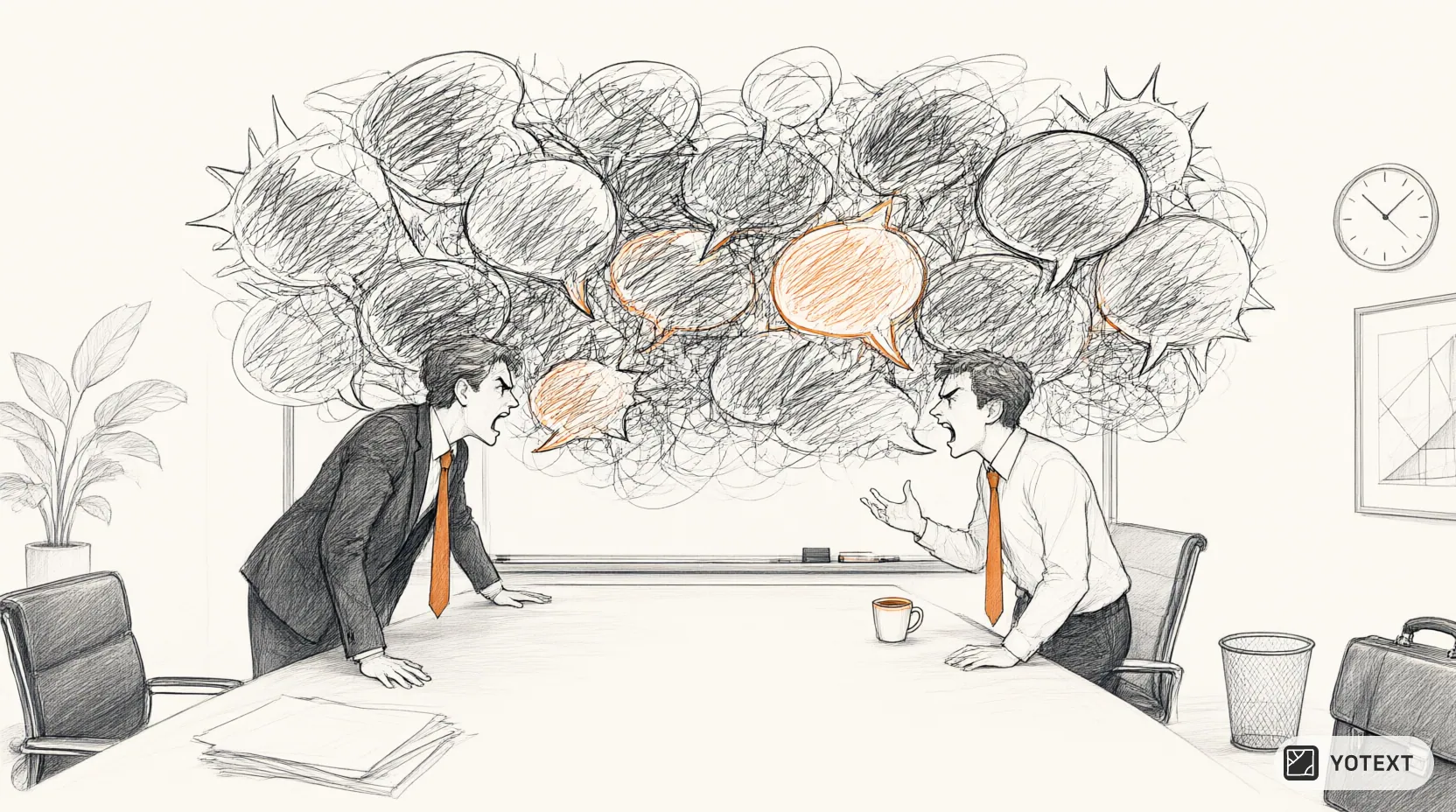
This situation is exacerbated by time pressure. Participants feel the need to conclude quickly so the meeting can end, forcing unresolved critical points into vague general summaries. The result is minutes stating 'agreed to proceed' without explaining the parameters of that continuation. When execution begins, these interpretation gaps trigger new conflicts that could actually have been prevented if the previous discussion structure had been clearly mapped.
Transcripts as Raw Data for Analysis
The technical solution to this problem lies in the availability of accurate raw data. YOTEXT provides a recording mechanism via a browser extension that captures audio from the meeting tab and the user's microphone without requiring a bot to join as a participant. This process generates live transcripts that can be shared during the meeting, creating real-time references for all parties involved.
The main advantage of these automatic transcripts is their objectivity. Unlike manual notes, which are subjective and often truncated, transcripts record every utterance as it happened. Speaker names are taken from captions or participant data if available, while neutral labels are used if identities are unclear. This ensures that statement attribution remains accurate, which is a crucial foundation for analyzing who proposed what and how reactions to those proposals occurred.
Building a Decision Matrix from Conversations
After the meeting concludes, the next challenge is transforming strings of words into an analytical structure. This is where YOTEXT features that generate summaries, decisions, and action items along with owners and deadlines become highly relevant. However, to identify deadlock points, we need to go beyond simple task lists. We need to construct a decision matrix that maps each discussed issue against its final status.
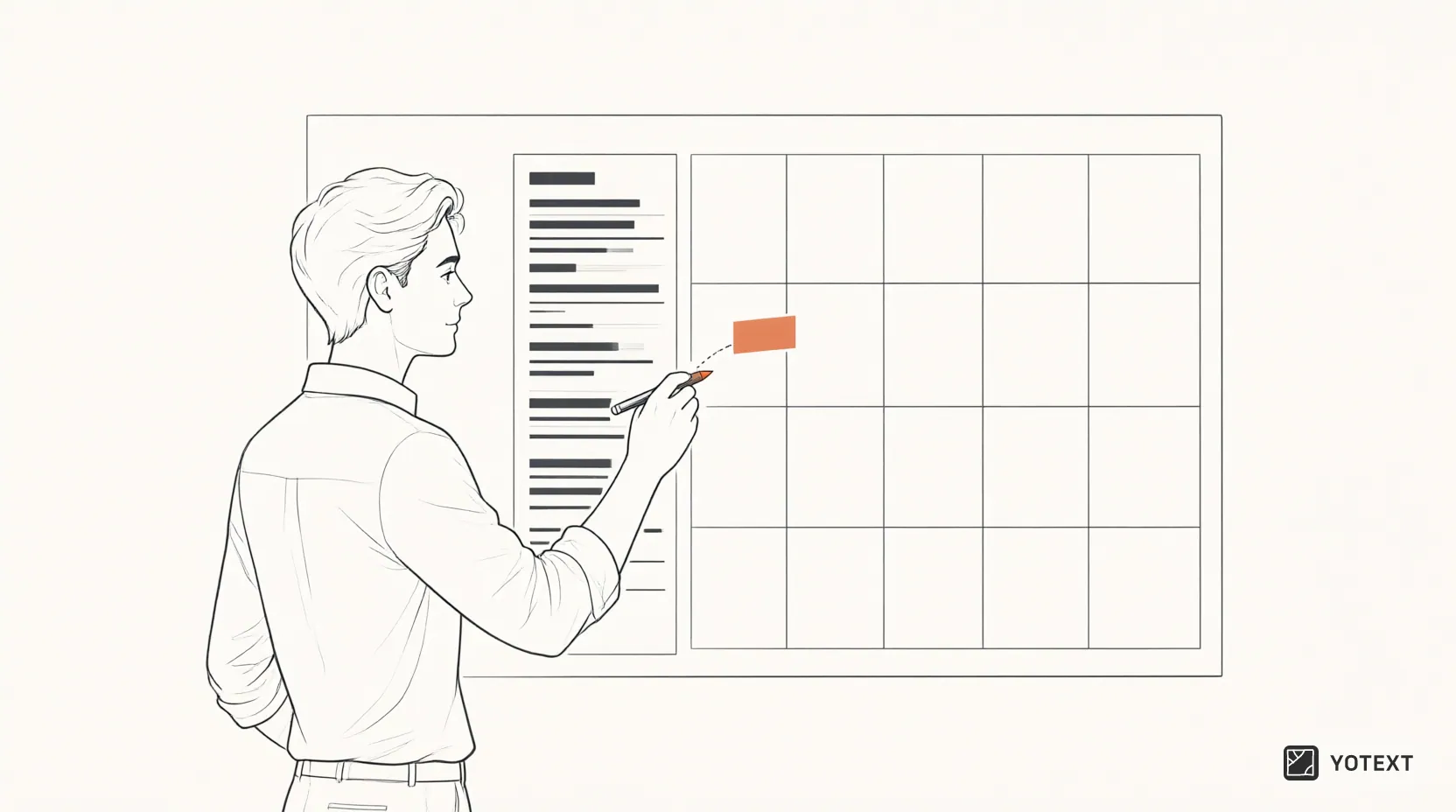
This process involves reviewing the complete transcript to isolate segments of discussion where intense debate occurred. By querying specific meeting content through YOTEXT's search feature, a team leader can rediscover specific moments when consensus failed to be reached. For example, searching for key phrases such as 'not yet agreed', 'needs validation', or 'high risk' can highlight areas that remain gray. From here, the matrix can be built with columns for 'Issue', 'Position A', 'Position B', 'Supporting Facts', and 'Final Status'.
This matrix structure forces the team to see patterns. If many issues end with a status of 'postponed' or 'needs additional data', it indicates that the meeting lacked preparation or access to information during the discussion. Conversely, if deadlocks occur on specific technical aspects, it may indicate a need for external experts or separate workshops, rather than just follow-up meetings.
Identifying Patterns of Communication Barriers
With a meeting history stored and searchable in a shared workspace, teams can conduct longitudinal analysis. YOTEXT's Team and Business plans allow storing meeting results in one place, facilitating comparison across sessions. If deadlock patterns continue to emerge on the same topics or involve the same people, this is no longer a content issue, but rather a process or interpersonal relationship issue.
For example, if the transcript shows that one team member always asks for clarification on details before giving approval, while others tend to make quick decisions based on intuition, the decision matrix will highlight this friction in working styles. Early identification of such patterns allows managers to adjust future meeting formats, for instance by establishing a rule that proposals must be accompanied by minimal supporting data before being discussed, to bridge differences in decision-making styles.
Cross-Validation and Context Correction
One risk of relying on technology is the potential for errors in voice or context identification. YOTEXT addresses this with a correction feature based on local recordings. If several participants in the same meeting use YOTEXT, each person's speech can be corrected using the recording from their own microphone. This ensures that the data entering the decision matrix is the most accurate representation of what the speaker intended.
Additionally, data security remains intact. Recordings are kept safe if the browser closes suddenly or the network disconnects, and can then be re-uploaded. Private meetings are visible only to their owner, and meeting results can be shared as full outputs or summaries only via revocable links. Granular control over information sharing is important when the decision matrix contains business sensitivities, enabling internal transparency without leaking strategy to external parties.
Practical Steps for Implementing the Matrix
To get started, teams need to change their post-meeting habits. Instead of sending narrative summary emails, use YOTEXT output as the basis for filling out a simple decision matrix template. The first column is filled with the main issues raised. The second column records the pro and con arguments captured in the transcript. The third column determines whether the final decision is clear, tentative, or at an impasse.

If the status is an impasse, add a 'Main Obstacles' column filled based on transcript analysis. Is the obstacle due to lack of data? Lack of authority? Or conflicting priorities? By classifying the type of deadlock, teams can choose the appropriate corrective action. For data-related deadlocks, schedule a research session. For authority-related deadlocks, escalate to the decision-maker. For priority-related deadlocks, hold a strategic goal alignment session.
It is also important to utilize the Q&A feature on meeting content. Before compiling the matrix, the meeting leader can ask the system, 'What was the main reason for rejecting Option B?' The answer generated from transcript analysis will provide direct quotes that strengthen the logical basis in the matrix, reducing speculation and accelerating consensus in the next iteration.
Conclusion
Transforming meeting transcripts into a decision matrix is not merely an administrative exercise, but a strategic effort to improve collaboration quality. By leveraging YOTEXT's ability to accurately record, transcribe, and summarize discussions, small teams can break free from exhausting cycles of deadlock.
This approach shifts the focus from 'who speaks the loudest' to 'what actually hinders progress.' When obstacles are objectively identified through conversation data, solutions can be designed with precision. Ultimately, meeting effectiveness is measured not by its duration, but by the clarity of direction produced afterward, and the decision matrix is the roadmap to that clarity.