
Contents
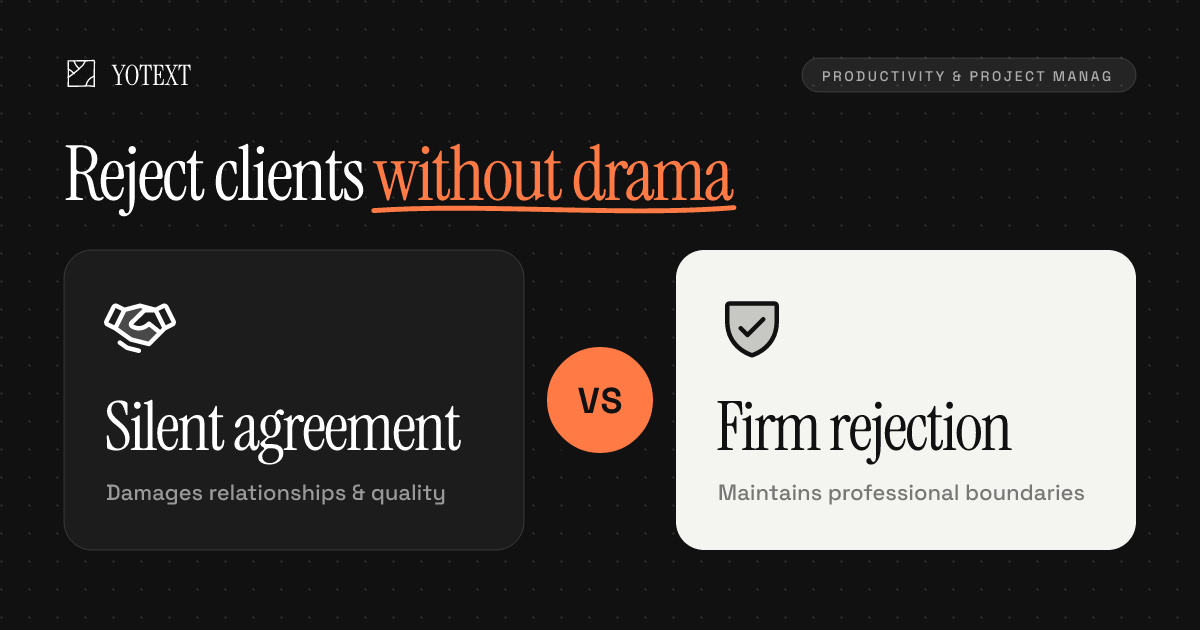
Many creative professionals and project managers feel awkward when they have to decline client requests. The fear of losing customers or being seen as uncooperative often drives them to agree to things that cannot realistically be fulfilled. As a result, there is scope creep without appropriate compensation, excessive time pressure, and a decline in the quality of the final output.
Declining does not mean cutting ties. On the contrary, the ability to set clear boundaries actually strengthens credibility and long-term trust. This article outlines calm yet firm communication mechanisms and how tools like YOTEXT can support these negotiation processes through accurate documentation.
Why Silently Agreeing Is More Dangerous Than Declining
When a professional avoids saying 'no' for social reasons, they often choose an ambiguous path. For example, answering urgent questions with phrases like 'I haven't included that in today's agenda,' hoping the client understands that the request cannot be fulfilled at that moment. This approach creates a wide space for interpretation by the client.

The client may respond in two equally harmful ways. First, they might think you are offering an alternative solution or asking for rescheduling, so they continue chasing confirmation. Second, they might feel guilty for disrupting your schedule, making subsequent interactions stiff and uncomfortable. In both scenarios, clarity is lost, and potential conflict is deferred until later.
Ambiguity in verbal communication often leads to misunderstandings in writing. If you do not explicitly state your inability to fulfill a specific request, the client has the right to assume it is still within the initial agreement's scope. This is the root of many project disputes that could have been prevented from the early conversation stage.
Three-Step Structure for Effective Refusal
The safest method for declining client requests involves three main components: acknowledgment, explanation, and alternatives. Acknowledgment shows that you value the client's idea or need. Explanation provides context on why the request cannot currently be met, whether due to technical or strategic resource limitations. Alternatives offer a way forward that remains aligned with project goals.

An example of its application is as follows: 'Thank you for the idea; it's an interesting direction. However, implementing it now would expand the project scope beyond our original plan. If you agree, we can schedule it as a separate phase after launch.' This sentence is firm yet collaborative. You are not closing the door but reprioritizing.
It is important to avoid a defensive tone or excessive apologies. Once you state 'unfortunately, we cannot do that,' do not follow up with a series of reasons that sound like self-justification. Hesitation is often interpreted by clients as weakness or an opportunity to negotiate harder. Certainty in message delivery is key.
Using Policies as a Neutral Shield
For recurring requests that fall outside standard operating procedures, having written policies is very helpful. Instead of making refusals feel personal, you can refer to the company's standard procedures. For example, if a client requests direct shipment without going through the receiving warehouse for inspection, you can explain that this step is an integral part of quality control.
Policy-based explanations shift the focus from 'my reluctance' to 'our quality standards.' You can say, 'We cannot bypass the warehouse inspection process because it guarantees every item arrives in perfect condition according to your specifications.' Thus, the refusal is positioned as protection of the client's own interests rather than a bureaucratic hurdle.
This approach reduces emotional tension in conversations. Clients are more likely to accept boundaries when they see consistent operational logic instead of feeling subjectively rejected by the service provider.
The Role of Meeting Documentation in Boundary Negotiations
Often, turning points in client-agency relationships occur during scope discussion or revision meetings. This is where tools like YOTEXT play a crucial role in maintaining communication accuracy. When you decline a new request, the direct transcript from that meeting becomes objective evidence of what was agreed upon and what was refused.
YOTEXT records audio from your browser tab without disruptive bot participants affecting the dynamics of the discussion. The live transcription panel allows all parties to view decisions made in real-time.
After the meeting system generates a summary of decisions and action items. If you decide to reject a sudden design change request, it is recorded as 'Decision Not Implemented in Phase 1'. This history is saved and can be retrieved later, preventing clients from claiming they forgot or misunderstood at a later date.
Offering Choices Instead of Just Refusal
Humans tend to accept 'no' more easily if it is followed by 'but'. Rather than simply stating inability, offer available options. If a client requests an impossible deadline, do not just say 'Cannot do it'. Try saying, 'To maintain quality, we need additional time. Would you prefer a phased launch next week or the full version next month?'

Giving control to the client in the form of choices restores their respect for your work process. They feel heard and respected even though their initial request was not fully met. This strategy turns confrontation into collaboration.
In the context of using YOTEXT, you can share a link to the meeting summary that includes those options. These revocable links ensure that sensitive information remains private while transparency regarding alternative solutions is maintained. Clients can calmly review their choices after the meeting ends.
Handling Pressure and Bullying Professionally
There are times when clients try to pressure agencies with threats or unethical demands. In these situations, consistency between spoken words and written records becomes the primary line of defense. Never agree to things that violate professional principles just because you fear losing the contract.
If a client demands risky actions, ask them to confirm the request in writing via email or official chat. Often, when asked to document unreasonable requests, clients back down upon realizing the legal or reputational implications. Tools like YOTEXT help capture the nuances of these conversations; complete transcripts record who proposed what, when, and in what context.
Having searchable meeting memory allows you to refer back to previous statements. If a client changes their mind or tries to twist the facts, you can point to the original transcript showing that you provided clear warnings or refusals from the start.
Workflow Integration: From Conversation to Decision
The process of rejecting clients does not stand alone; it connects with daily task management. After a 'no' decision is made in a meeting, it must be reflected in the team's task list. YOTEXT collects action items from various meetings into one centralized list, ensuring that the rejection of feature X does not secretly slip into the developer backlog.
Shared workspaces in the Team or Business package allow all team members to view this decision history. If a new designer joins and asks why a certain feature was not built, they can search the meeting archives and find the context of the rejection. This prevents repeating mistakes or unnecessary renegotiations.
Thus, technology does not just record voice but also institutionalizes organizational knowledge. Boundaries set today become precedents for future projects, creating a healthy and sustainable work culture.
Conclusion
Setting clear boundaries is a long-term investment in the health of your creative business. By combining assertive communication techniques with meeting recording technology support, you can navigate difficult requests without compromising project integrity or client relationships.
Sources
Material 1: https://mydomastudio.com/how-to-say-no-to-clients/
Material 2: https://www.trinityp3.com/agency-new-business/saying-no-to-clients/
Material 3: https://reallygooddesigns.com/how-to-say-no-to-clients/